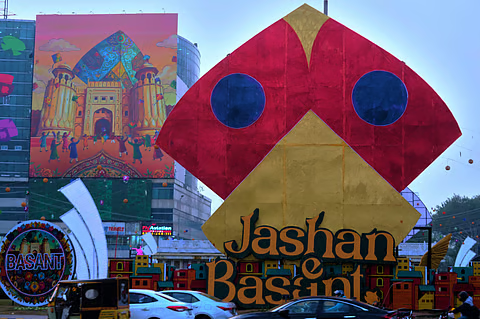
Basant is one of the subcontinent's major cultural festivals, with a history that traces back centuries. Unfortunately, this vibrant tradition was disrupted due to the challenges Pakistan has faced over the past decades. The festival was banned in 2007 due to an increasing number of deaths and serious injuries caused by dangerous kite strings, particularly affecting motorcyclists and pillion riders, as well as celebratory gunfire.
Instead of implementing proper regulations, authorities chose a complete ban on the event, which lasted for 18 years.
Cultural Revival Under New Leadership
The current government of Punjab, under Chief Minister Maryam Nawaz Sharif, approved the revival of Basant Festival on February 6, 7, and 8, 2026, after 18 years, marking a significant milestone in restoring Punjab's cultural identity. The government has been actively working to revive the Punjabi language and culture, which had diminished in public spaces. Initiatives include public signboards in Punjabi and government programs branded in the local language, such as "Suthra Punjab" (Clean Punjab).
According to Punjab Senior Minister Marriyum Aurangzeb, this revival celebrates "a tradition rooted in history and admired worldwide," emphasizing that the festival has historical significance dating back to the 19th century when Maharaja Ranjit Singh introduced kite flying as a regular feature of the annual Basant fair.
The decision to revive Basant was politically sensitive given the tragic history. However, Chief Minister Maryam Nawaz stated, "We cannot get a better occasion than this to portray Pakistan's progressive image to the world."
Economic Impact of Basant
Cultural events play a crucial role in reviving local economies, and Pakistan has been experiencing economic challenges for years. Chief Minister Maryam Nawaz confirmed that Basant has generated business worth billions of rupees, benefiting kite manufacturers, hotels, and restaurants.
Impact on Low-Income Households and Cottage Industries
The festival supports an extensive cottage industry economy that includes kite manufacturing, string production, dyes, paper suppliers, bamboo cutters, wholesalers, and thousands of seasonal vendors. Unlike factory-produced goods, kites are traditionally manufactured in suburban areas and residential workshops, providing employment opportunities for families with limited income options.
On the first day of authorized sales, approximately 400,000 kites and 15,000 string spools were sold, with kite prices ranging from Rs 200 to Rs 500 and string prices from Rs 7,000 to Rs 15,000. This economic activity directly benefits low-income households who have been engaged in kite-making for generations.
The revival has opened up fresh earning opportunities for laborers and daily wage workers who are actively participating in the seasonal trade. Traditional drum beaters, flower vendors, and food sellers are all experiencing a surge in business, with the festival creating a ripple effect throughout the local economy.
Tourism and Hospitality Boom
The festival has sparked unprecedented tourism activity. Chief Minister Maryam Nawaz noted that "people from around the world are coming to Punjab. All the hotels and guest houses are booked." Rooftop rental prices have soared, with packages ranging from Rs 500,000 up to Rs 3 million for the three-day celebration, demonstrating the significant economic activity generated by the festival.
Flight bookings from other Pakistani cities to Lahore have reached capacity, indicating strong domestic tourism demand. The economic benefit extends beyond direct kite sales to include hospitality, transportation, food services, and entertainment sectors.
Comprehensive Regulatory Framework
Learning from past tragedies, the government has implemented the Punjab Kite Flying Ordinance 2025, creating an unprecedented regulatory framework to ensure public safety.
Digital Registration and Traceability
All individuals and businesses involved in Basant-related activities must register through the eBiz Punjab system, with applications reviewed by Deputy Commissioners within 10 days. Over 2,150 manufacturers, traders, and vendors have been formally registered, with more than 10,000 surety bonds obtained to ensure compliance.
Every kite must carry a QR code linked to the manufacturer and seller, creating complete traceability throughout the supply chain. This innovative system allows authorities to track products from production to final sale, ensuring accountability and safety standards.
Safety Measures and Enforcement
The government has imposed strict regulations: only cotton string is allowed, while metallic, chemical-coated, and glass-coated strings are completely banned. Kite sizes have been standardized to 35×30 inches for kites and 40×34 inches for spools, with only nine-thread cotton string permitted.
To protect motorcyclists—the most vulnerable group during past festivals—the Punjab government has installed one million free safety rods on motorcycles at a cost of over Rs 110 million.
Zoning and Monitoring Systems
Lahore has been divided into Red, Yellow, and Green zones, with each having specific restrictions and monitoring levels. More than 4,000 police personnel, along with Suthra Punjab workers, are deployed across Lahore, with Rescue, Fire Brigade, Ambulance, and Health departments on full alert.
Chief Minister Maryam Nawaz confirmed that all street activities are being monitored through drone surveillance from a control room at the Safe City office. CCTV cameras provide 24/7 monitoring, ensuring rapid response to any incidents.
Legal Consequences
Violations of the Punjab Regulation of Kite Flying Act can result in imprisonment ranging from five to seven years and fines up to Rs 5 million. These strict penalties demonstrate the government's commitment to preventing the tragedies that led to the original ban.
Public Holiday Declaration
Chief Minister Maryam Nawaz announced that Punjab will enjoy a long weekend, with Kashmir Day on February 5, a provincial Basant holiday on February 6, followed by Saturday and Sunday. This four-day extended break allows families across Punjab to participate in or visit the celebrations, further boosting tourism and economic activity.
Looking Forward
The Pakistan Meteorological Department forecasted mainly dry weather with clear skies on February 6 and 7, with light westerly winds suitable for safe kite-flying. These favorable conditions set the stage for a successful revival.
Information Minister Azma Bokhari stated that the festival would be "completely safe, regulated, and strictly monitored," emphasizing that this is being organized as a pilot project in Lahore to evaluate the effectiveness of security protocols and standard operating procedures.
This event showcases a positive image of Pakistan and restores Punjab's cultural identity, which had been dormant for nearly two decades. The economic impact brings positive change locally and has the potential to uplift communities across the region. By balancing cultural celebration with modern safety measures, Basant 2026 demonstrates that traditional festivals can thrive in contemporary society when properly regulated.
The success of this pilot project could pave the way for Basant celebrations in other Punjab cities in future years, potentially multiplying the economic and cultural benefits across the entire province.
Pakistan Zindabad.
About the Author
Muhammad Salman Tanveer is currently pursuing his Master's degree in Financial Technologies with a minor in Economics in France. He previously served as curator of multiple technology and startup events in Pakistan, bringing extensive experience in analyzing the intersection of culture, economics, and innovation.